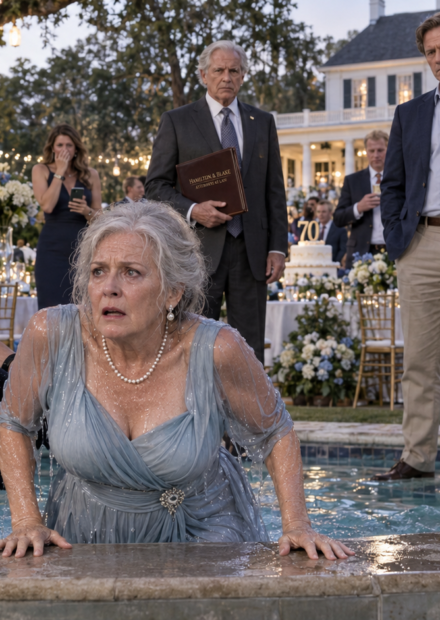
Chapter 4 – THE PRICE OF KEEPING PEACE
I did not accuse Madison of stealing from me.
That would have been easy.
It also would have been irresponsible.
I had spent too many years as a principal listening to parents arrive in my office with half a story and a complete verdict.
Facts mattered.
So I asked Ethan to show me the spreadsheet.
He opened it on his phone.
The document itself was ordinary.
Flowers.
Photography.
Music.
Food.
Venue.
Transportation.
Rentals.
There were columns showing deposits, balances, and estimated final amounts.
Near the bottom sat a line labeled FAMILY CONTRIBUTION.
Beside it was a number significantly higher than the amount I had promised.
I pointed to it.
“Who entered this?”
“Madison made the sheet.”
“Did she tell you I agreed to this?”
“Yes.”
“When?”
“A few weeks ago.”
“And you didn’t ask me?”
He looked ashamed.
“She said you two had already talked.”
“We hadn’t.”
“I should’ve checked.”
“Yes.”
The answer came out more sharply than I intended.
I softened my voice.
“Yes, you should have.”
He nodded.
“I know.”
This time I let him say it.
“How much has actually been charged?” I asked.
“I don’t think anything was charged directly to you beyond what you already paid.”
“Then where did the extra money come from?”
“Some vendors still had balances due after the wedding.”
I exhaled.
That was better than money being taken from me without permission.
But not much better.
Someone had planned a wedding assuming I would eventually cover a large amount I had never promised.
“Did Madison expect me to pay the difference afterward?”
“I think so.”
“You think so?”
“She said you’d told her not to worry about it.”
I looked at him.
“I have never told Madison not to worry about money.”
The sentence almost made us both smile because it sounded exactly like something David would have said about me.
The smile never fully arrived.
Ethan locked his phone.
“I need to talk to her.”
“Yes.”
He stood.
At the kitchen doorway, he stopped.
“Mom?”
“Yes?”
“Did Dad ever tell you he thought I avoided conflict?”
I stared at him.
“Why?”
“Because he told me once.”
I had forgotten that.
“When?”
“I was twenty-two. We had that argument about me dropping out of the graduate program.”
I remembered.
Ethan had enrolled in business school because several friends were doing it.
Three months later, he knew he hated it.
He was afraid to tell David.
Instead, he told me.
I spent two weeks softening the ground before Ethan finally admitted the truth.
David had been more irritated by the secrecy than the decision.
“What did he say?” I asked.
Ethan leaned against the doorway.
“He said, ‘Your mother thinks protecting you from uncomfortable conversations is kindness. Don’t make her pay for that mistake forever.’”
My chest tightened.
“That sounds like your father.”
“I thought he was being dramatic.”
“So did I.”
Ethan gave me a sad smile.
“I’ll call you.”
“Don’t call me to report every argument.”
“I wasn’t going to.”
“Yes, you were.”
He almost laughed.
Then he nodded.
“Probably.”
When he left, I stood in my kitchen for a long time.
The truth about parenting is that the job changes long before your instincts do.
When Ethan was six, stepping between him and danger had been love.
At thirty-three, stepping between him and consequences could become something else entirely.
Control.
Fear.
Even selfishness.
Sometimes rescuing a grown child is less about helping them than about relieving your own discomfort while watching them struggle.
That morning, I decided Ethan’s relationship with Madison belonged to Ethan.
My relationship with Ethan belonged to me.
I would deal only with the part that was mine.
The first practical issue arrived at noon.
Natalie called.
“How are you feeling?”
“Like I’ve been slapped at a wedding.”
She sighed.
“I deserved that.”
“You didn’t slap me.”
“No. But I keep replaying yesterday and wondering whether I should’ve intervened sooner.”
“You came when you knew something was wrong.”
“I need to discuss the contract.”
“Of course.”
Natalie explained that because the ceremony had not proceeded, Bellamy House was finalizing charges only for services actually rendered and nonrefundable vendor commitments managed through the venue.
The reception meal had been prepared.
Staff had worked.
Flowers had been installed.
Musicians had performed.
There would be losses.
I had expected that.
“What do I owe?”
She gave me the preliminary figure.
Painful.
But manageable.
“I’ll pay the amount covered by my agreement,” I said.
“You aren’t responsible for independent vendors.”
“I know.”
“And Claire?”
“Yes?”
“I want to be very clear. You did not cancel the wedding over a disagreement.”
I closed my eyes.
“Thank you.”
“We paused an event after a physical incident involving the contracting client. You then chose not to continue your authorization.”
“Madison will not describe it that way.”
“Madison doesn’t write our incident reports.”
For the first time in twenty-four hours, I smiled.
“Thank you, Natalie.”
“There is something else.”
I waited.
“The bride’s parents asked whether they could assume the contract and continue later that evening.”
My stomach tightened.
“What did you say?”
“That the date could not simply be transferred after what had occurred.”
“Did Ethan know?”
“I don’t know.”
I thought about that.
“Why are you telling me?”
“Because if you hear later that Bellamy House refused them, I don’t want you thinking we were trying to force you to remain involved.”
“I appreciate that.”
After we ended the call, I sat at the dining table and looked across at David’s empty chair.
For six years, I had made difficult decisions alone.
Not because I wanted independence.
Because death had required it.
There are people who describe widowhood as loneliness.
It is.
But it is also the sudden disappearance of the person who remembers the earlier versions of you.
David remembered me at twenty-three, terrified before my first classroom observation.
At thirty-one, sitting on the bathroom floor after a miscarriage we rarely spoke about afterward.
At thirty-six, holding newborn Ethan and laughing because David had fainted during delivery.
At forty-eight, applying for the principal position I was convinced I wasn’t qualified to take.
At fifty-six, dancing badly in our kitchen.
He had known the whole line of me.
Without him, every decision felt as if it began in the middle of a book whose opening chapters only I could still read.
That was one reason I had clung so tightly to Ethan after David died.
He carried my history.
But he was not supposed to carry my entire future.
That afternoon, I called the seamstress who had altered my wedding gown.
Not because I intended to wear it again.
I simply wanted to know whether it could be repaired.
“Bring it in,” she said.
I almost told her what happened.
Instead, I said, “It has sentimental value.”
That surprised me.
The dress had not been sentimental when I bought it.
Now it was.
Not because of the wedding.
Because it marked the moment I stopped disappearing to make other people comfortable.
Two days passed before Ethan called.
I let it ring twice.
Then answered.
“Hi.”
“Hi, Mom.”
His voice sounded tired.
“Are you safe?”
“Yes.”
“Where are you?”
“At the apartment.”
“Madison’s there?”
“No.”
Something tightened in my chest.
“Where is she?”
“With her parents.”
I sat on the edge of the sofa.
“What happened?”
“We talked.”
I waited.
“It didn’t go well.”
“I am sorry.”
He laughed bitterly.
“Are you?”
“Yes.”
“Even after everything?”
“I didn’t want your marriage destroyed, Ethan.”
“We weren’t married.”
“You know what I mean.”
He was quiet.
“She says you’re manipulating me.”
“What do you think?”
“I think she believes that.”
“That wasn’t my question.”
“I know.”
Another pause.
“I think I’ve been letting people tell me what reality is because choosing one version meant somebody would be angry with me.”
That sounded painfully familiar.
“What did she say about the spreadsheet?”
“She said she assumed you would cover the rest.”
“Based on what?”
“Based on ‘everything you’ve done before.’”
I closed my eyes.
That phrase landed differently than I expected.
Everything you’ve done before.
Maybe Madison had misunderstood me because Ethan had taught her to.
How many times had he told her, Mom will take care of it?
Mom doesn’t mind.
Mom can help.
Mom always comes through.
My own generosity had become a resource in their relationship.
Something they planned around.
Not because they were monsters.
Because I had made myself predictable.
“And the extra thirty thousand?” I asked.
“She thought if we were over budget, you’d rather pay than let us start married life in debt.”
I almost admired the logic.
It was wrong.
But it was based on years of evidence.
“Did you?”
“Did I what?”
“Think I would pay.”
Ethan hesitated.
“Yes.”
There are moments when a small truth hurts more than a large lie.
I stood and walked to the window.
Outside, a neighbor was trimming roses.
Ordinary life continued.
“I see.”
“I’m sorry.”
“Thank you for telling me.”
“Mom, I didn’t think about it as taking advantage.”
“I know.”
“I just thought…”
“That I would fix it.”
“Yes.”
There was no point punishing him for finally being honest.
“So what happened with Madison?”
“I asked why she said you’d approved the number.”
“She said she didn’t remember saying that.”
“But she told you I had.”
“I know.”
“Did you tell her Lauren moved the place card?”
Silence.
I straightened.
“Ethan?”
“Yes.”
“What did she say?”
“She said that wasn’t the point.”
Of course.
When facts become inconvenient, people often announce that facts were never the point.
“What was the point?”
“That you were interfering.”
“By repairing her veil?”
“She says it’s a pattern.”
“Do you believe her?”
“No.”
The answer came quickly this time.
I noticed.
“She also says,” Ethan continued, “that if you loved me, you would have signed the authorization and dealt with her afterward.”
I sat down again.
“And what do you think?”
“I think that’s exactly what I wanted you to do.”
I said nothing.
“And I think,” he continued, “I wanted it because I knew you were the person most likely to accept being hurt for my sake.”
My eyes filled.
He had understood.
Not everything.
But that.
“Yes.”
His voice cracked.
“I’m sorry.”
I let myself cry quietly.
“I love you.”
“I love you too.”
“That doesn’t mean we’re okay.”
“I know.”
“Good.”
We talked for another twenty minutes.
Not about whether Ethan should stay with Madison.
I refused to give an opinion.
When he asked, I said, “Marriage is too important for you to outsource that decision to me.”
He understood.
Or at least he said he did.
Three days later, Madison came to my house.
Alone.
I saw her through the front window before she rang the bell.
She wore jeans, a beige sweater, and sunglasses.
For a moment, she looked younger.
Not like a bride.
Not like an antagonist.
Just a woman standing on a porch trying to decide what to do with the consequences of something terrible.
I opened the door but did not invite her in.
“Hello, Madison.”
She removed the sunglasses.
Her eyes were tired.
“Can we talk?”
“About what?”
Her lips tightened.
“Everything.”
“That is a large subject.”
“I know.”
I stepped onto the porch and closed the door behind me.
She noticed.
The message was clear.
She was not entering my home.
“Ethan isn’t speaking to me,” she said.
“I am not involved in that.”
“He talks to you.”
“He is my son.”
“So you do know what’s happening.”
“I know what he chooses to tell me.”
“He ended our engagement.”
The words surprised me.
I had spoken to him the previous night.
He had said only that things were bad.
“When?”
“This morning.”
I swallowed.
“I’m sorry.”
Madison stared at me.
“No, you’re not.”
“I am sorry that something all of you invested so much hope in has ended painfully.”
“That’s a very principal answer.”
Perhaps it was.
“What do you want from me?”
“I want you to tell him you forgive me.”
I blinked.
“That isn’t something I can tell Ethan.”
“You can forgive me.”
“That is different.”
“If you tell him you’re okay, maybe he’ll stop acting like I committed some unforgivable crime.”
My expression changed.
Madison saw it.
“I know hitting you was wrong.”
“Do you?”
“Yes.”
“Then why did you just call Ethan’s response an overreaction?”
She looked away.
“I was under incredible stress.”
“So was everyone at that wedding.”
“You were pushing me.”
“No.”
“You don’t even see it.”
“I see that you believed I criticized your spending when I had not. I see that you blamed me for moving place cards I never touched. I see that when I denied both things, you hit me.”
“You always sound so calm.”
The bitterness in her voice startled me.
“What does that have to do with anything?”
“Do you know what it’s like arguing with someone who never loses control?”
I almost laughed.
“Madison, are you telling me you hit me because I stayed calm?”
“No.”
“It sounds remarkably close.”
She rubbed her forehead.
“You make people feel like children.”
That stopped me.
As a principal, I had heard versions of that criticism.
As a mother, perhaps I had earned it sometimes.
I considered her words.
“Maybe I have spoken to you in ways that felt patronizing.”
She looked surprised.
“If I did, I am willing to examine that.”
Her shoulders loosened slightly.
“But nothing I said gave you permission to hit me.”
They tightened again.
“There it is.”
“Yes. There it is.”
“You won’t let it go.”
“It’s been four days.”
“I apologized.”
“You haven’t.”
“I just said I know it was wrong.”
“That is acknowledgment.”
“What do you want me to do, get on my knees?”
“No.”
“Then what?”
“I want nothing from you.”
She stared at me.
That answer seemed to unsettle her more than anger would have.
“I don’t need an apology so I can control Ethan,” I continued. “I don’t need you humiliated. I don’t need revenge. I need distance.”
“You ruined my wedding.”
“No.”
Her eyes flashed.
“You signed the cancellation.”
“I declined to continue my authorization after you assaulted me.”
“Same thing.”
“No.”
“Everyone thinks you canceled it because you hate me.”
“Who is everyone?”
“My family.”
“Your family is allowed to think what they want.”
“Your friends too.”
“My friends have heard almost nothing from me.”
She blinked.
I realized then that she had expected a public war.
Perhaps she had spent the last four days imagining me calling guests and telling my version.
I had not.
I had told two people.
My oldest friend, Ruth.
And my sister-in-law.
That was all.
“I haven’t been campaigning against you, Madison.”
“Then why is Ethan leaving me?”
“I think you should ask Ethan.”
Her face crumpled.
Not dramatically.
Just for a second.
And despite myself, I felt compassion.
Human beings are inconvenient that way.
Someone can hurt you and still be hurting.
Seeing their pain does not erase yours.
“Claire,” she said softly, “I love him.”
“I believe you.”
“Then help me.”
“I cannot.”
“Why?”
“Because if I tell Ethan to stay with you, then I’m doing the very thing you’ve accused me of doing for years.”
She stared.
“Controlling him.”
The word hung between us.
“I will not decide who my adult son marries.”
“So that’s it?”
“No.”
I looked at her.
“There is one thing I will say to him if he asks.”
“What?”
“That you came here.”
Hope appeared in her face.
“And?”
“And that you said you know hitting me was wrong.”
Her expression faded.
“That’s all?”
“That is all that happened.”
She put the sunglasses back on.
“Do you know what I think?”
“I suspect you’re going to tell me.”
“I think you wanted him back.”
The accusation hurt because it touched something complicated.
After David died, Ethan had become more central to my life than he should have.
I knew that now.
But wanting closeness was not the same as wanting possession.
“I think,” I said carefully, “there were years when I relied on Ethan too much emotionally.”
Madison had not expected that answer.
“So you admit it.”
“I admit what is true.”
She waited.
“I also think Ethan relied on me too much practically. Neither of those things gave you permission to hurt me.”
Her mouth tightened.
“You always have an answer.”
“No. I just stopped accepting yours.”
She left without another word.
I watched her drive away.
Then I went inside and locked the door.
That evening Ethan called.
“Madison went to see you.”
“Yes.”
“Why didn’t you call me?”
“Because she came to speak to me.”
“What did she say?”
I told him.
Everything.
Even the parts that made me uncomfortable.
Especially those.
When I finished, he was silent.
“Did she apologize?” he asked.
“She acknowledged that hitting me was wrong.”
“That isn’t what I asked.”
“No.”
He exhaled.
“I ended it.”
“She told me.”
“I thought you’d say something.”
“What would you like me to say?”
“I don’t know.”
I waited.
Finally he said, “Tell me I did the right thing.”
I closed my eyes.
“No.”
“Mom.”
“You asked me four days ago what you were supposed to do. I refused to decide then. I’m not going to decide afterward so you can avoid owning the choice.”
“That sounds harsh.”
“It may be.”
“What if I made a mistake?”
“Then it will be your mistake.”
He was quiet.
“And if ending it was right,” I continued, “that will also be yours.”
He laughed weakly.
“Dad would love this version of you.”
“I am starting to find her exhausting.”
That made him laugh for real.
It was the first clean sound between us since the wedding.
Then he became serious.
“Mom?”
“Yes?”
“I didn’t end it only because she hit you.”
“I hope not.”
“I ended it because when I asked her why she hit you, she kept explaining why you made her angry.”
I said nothing.
“And when I told her I had failed you, she said I should be angry at you for making me choose.”
My heart hurt.
“I’m sorry.”
“She thinks love means choosing the person who demands the choice.”
“That sounds lonely.”
“It was.”
I looked out the window.
A storm was beginning.
Rain touched the glass in scattered drops.
“I need to tell you something else,” he said.
“What?”
“After I ended it, she asked whether I expected her parents to reimburse you for the wedding.”
I frowned.
“What did you say?”
“That money was between you and the contracts.”
“She shouldn’t owe me anything that wasn’t legally hers.”
“I know.”
He paused.
“Then she said, ‘Good. Because your mother can afford it.’”
I closed my eyes.
There it was.
Not greed exactly.
Something simpler.
Entitlement.
The belief that my ability to absorb a loss meant the loss did not matter.
I had helped build that belief in my son.
Perhaps Madison had merely stepped into a system already waiting for her.
“Ethan.”
“Yes?”
“I want you to hear this carefully.”
“Okay.”
“I am not angry because the wedding cost money.”
“I know.”
“I am angry because people I loved began treating my willingness to help as proof that I had no limits.”
He was silent.
“That includes you.”
“I know.”
“And changing that will take more than one apology.”
“I know.”
This time, when he said it, I believed he did.
—